
As a cancer survivor myself and a person of faith, I am praying for Pope Leo's full healing as he faces his battle with the cancer demon. I hope anyone who reads this will join me. And please pray for cancer sufferers everywhere.

As a cancer survivor myself and a person of faith, I am praying for Pope Leo's full healing as he faces his battle with the cancer demon. I hope anyone who reads this will join me. And please pray for cancer sufferers everywhere.

Edison’s contemporaries.
In 1877, thirty-year-old Thomas Edison already had about 140 patents behind him and was on the cusp of bursting into international acclaim when he introduced the phonograph in December. That same year, two brothers, Albert and J.M. Anderson, founded the Albert & J.M. Anderson Manufacturing Company in Boston, which made electrical products. It started with bespoke machined parts. When electricity adoption took off in the 1880s, Anderson turned its attention to mass-produced switches for industrial applications and electric streetcars. In 1953 Anderson filed a patent for what would eventually become today’s Powerpoles. Ideal Electric bought Anderson in 2001 and ended Anderson’s 124-year run as a stand-alone corporation. The Anderson name and product line still thrive today as a subsidiary of Ideal.
The earliest ancestor of today’s Powerpole is the original 1953 SB connector. Industry was evolving quickly and needed DC power connectors that could satisfy what seems to be an unreasonable list of demands: genderless, solderless, capable of very high current, low resistance, hot-swappable, physically robust for harsh environments and rough handling, easy to install and work with, and cost-effective.
The “British Invasion” music movement. Johnson is President. The Powerpole is born.
The exact pedigree of Powerpoles is not very well documented. We do know Anderson first started using the name in 1965 and was granted a trademark by the U.S. Patent & Trademark Office in 1967. Between then and approximately 2000, the names “Anderson” and “Powerpole” were not in any radio amateur’s vocabulary. Anderson products were used almost exclusively in commercial and industrial applications. In the 1970s and 1980s, another company, Molex, became prominent as a major manufacturer of automotive connectors, and that carried over to ham radio. The term “Molex connector” evolved into a generic name for ham radio power plugs even when referring to other companies’ knockoff versions.
The seeds were planted.
Going into the 1990s Powerpoles were still virtually unknown in the ham universe. But the versatility of the device set it up to be a sleeper hit. Everything that made them excellent for industry also made them an obvious choice for amateur radio. So why wasn’t anyone using them? The answer is unsatisfactory: no one really knows for sure.
One possibility is that, in the 1990s, hams would likely turn to Molex for homemade projects because that was the traditional “go-to” product and any Radio Shack or neighborhood auto parts store sold them. Radio manufacturers in turn just kept doing what they had always been doing. Stasis is hard to break; the “holy grail” of standardization and interoperability was closer than ever, but no one realized it…yet.
The dam breaks.
Several people have asked me lately what it’s going to be like as we move out of Solar Cycle 25 and eventually into the quieter years between solar cycles.
I understand the question and why so many ask.
There’re a lot of new amateur radio operators who came into the hobby during the pandemic. Many of them discovered amateur radio through things like Parks on the Air (POTA), Summits on the Air (SOTA), portable operating, and DXing. They’ve experienced a pretty active solar cycle in the past few years, and for some of them, this will be their first experience with the other side of the cycle.
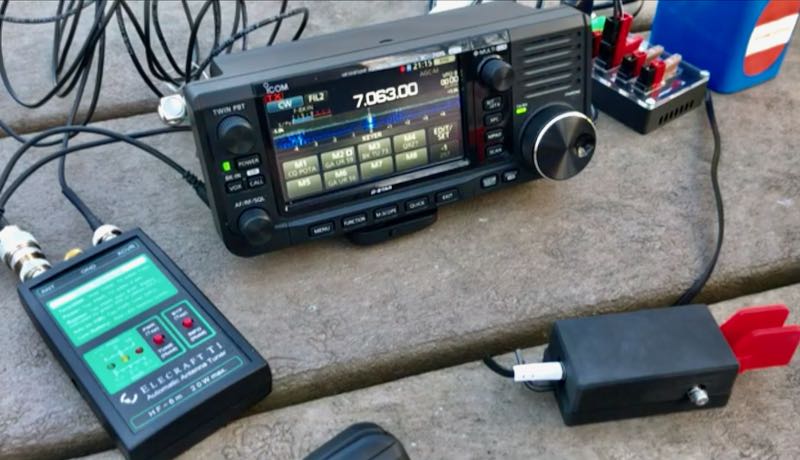 First, let me be clear, in Douglas Adams terms: Don’t Panic!
We’re not watching the end of amateur radio. We’re simply entering a different part of the cycle.
I’m not a solar physicist or a propagation expert, so I’m not going to even attempt to explain the science behind solar cycles here.
What I can do is talk about what I’ve experienced as an amateur radio operator since 1997, and especially what I’ve learned operating portable and QRP through different conditions.
And I think there’s some good news.
 Solar Cycle 25 reached its maximum phase in 2024, according to NASA and NOAA, and we’re now moving into the declining phase of the cycle. We still don’t know exactly when we’ll reach the next solar minimum, but we’re talking years rather than months.
If I’m being honest here, I sometimes felt that we were a little cheated by this solar cycle.
The numbers were good. There were plenty of sunspots, and I experienced some of the best DX I’ve ever worked from the field. But there was also considerable instability, including geomagnetic storms that sometimes seemed to arrive just when conditions otherwise looked promising. I recall several Hamvention weekends in a row when conditions were so poor, groups of us struggled to make contacts even when there was a lot of spotted activity.
That’s one of the things I’ve learned over the years: no two solar cycles are exactly alike, and even within one cycle, conditions can vary enormously.
When I first became licensed in 1997, I remember some periods when 10 meters was absolutely spectacular–effortless, armchair copy transatlantic voice contacts at QRP levels. During the current cycle, I’ve certainly enjoyed 10 meters and the other higher bands, but I don’t feel that I’ve experienced the same consistently spectacular conditions I remember from those earlier years.
That’s just the way it is.
Sometimes the Sun cooperates. Sometimes it doesn’t.

For many scanner listeners, the appeal is easy to understand. You turn on a radio and, without knowing what will happen next, you can hear pieces of real life unfolding around you: a fire call, an aircraft approaching an airport, a railroad crew at work, severe weather reports, public works activity, or emergency responders handling an incident.
But how did listening to public-safety radio become a hobby in the first place? The answer starts decades before the modern police scanner existed. The hobby grew alongside police radio itself, then changed repeatedly as communications technology moved from early AM broadcasts to VHF and UHF, crystal-controlled scanners, programmable radios, trunked systems, digital communications, online databases, and today's sophisticated receivers.
In other words, the history of scanning is not simply a history of old radios. It is a history of people wanting to know what was happening around them, and technology gradually making that easier.


With heavy hearts, the Massachusetts State Police announce the unexpected death of Trooper Jacob Mick who died from injuries sustained in an off-duty motorcycle crash in Grafton.
A member of the 88th Recruit Training Troop assigned to the Holden Barracks, the life of this 31-year-old Northboro native has been cut short by this enormous tragedy.
Speaking of the late Trooper, the Superintendent of the State Police, Colonel Geoffrey Noble said, “Together, we mourn Trooper Jacob Mick, and extend our deepest sympathies to his wife, their infant daughter, his family, and all who loved him. He was a proud Trooper and public servant who never hesitated to answer the call. We remember and honor Trooper Mick’s years of service, and all he gave to the Commonwealth as well as to the Department.”
Trooper Mick graduated from the Massachusetts State Police Academy in 2023.
The facts and the circumstances of the crash remain under investigation by the Worcester County District Attorney’s Office.
At this time, the Mick Family requests privacy as they grieve. Further information will be provided as it becomes available.
I'm personally devastated by this. I'm not 100% sure, but this young Trooper looks like the young off duty trooper who assisted me at the scene of a motorcycle accident at the exact same location last October. I was the first to arrive and together we applied first aid. I'll never forget his calm professionalism and compassion.
Whether this is the same trooper or not, it makes no difference. This is a devastating loss for his loved ones and the Commonwealth he served.
Rest in peace Trooper.

Posted in The Broadcaster's Desktop Resource
By Barry Mishkind
You may never look at a USB thumb drive or cable the same way after reading this. What was just a precaution that seemed like overkill now may be a warning we need to know. See how this all progressed.
USB devices are so common that most people plug them in without a second thought. But that casual habit carries real risks — from data theft to hardware destruction. Here is why you should think twice before connecting an unknown USB device.
Some years ago, I had the opportunity to visit the office of a fairly well-known Group Chief Engineer. As we talked, I offered him a flash drive with information about a matter about which we had previously spoken and emailed. His response surprised me.
“That will not work. All the USB ports in our computers have been disabled and/or blocked. The only exception is one completely isolated unit in the studio for talk show guests,” he said. “If you want to get that information to me, just send it in an email.”
POLICY OVERKILL?
At first, I was taken aback. Flash drives were the key to the “sneaker network” many of us used all the time.
Getting information from studio to transmitter, for example was much easier when we could put it in our pocket and connect on site. IP and network connections, logins, and directory searches were bypassed in a moment.
But, here, all the USB ports were not only disconnected, many (most?) were actually blocked from accepting the plug at all.
A REASON FOR THE TIME
It only took a few minutes for the group chief to explain why this policy evolved.

The primary goal of this workshop is to provide a forum that enables software defined radio (SDR) enthusiasts to get together, collaborate, and introduce SDR concepts to those interested in furthering their knowledge of SDR capabilities and available resources. NEWSDR 2026 welcomes experienced SDR enthusiasts as well as individuals who are interested in getting started with SDR.
John Swoboda, Ph.D., Geospace Research Scientist at the Massachusetts Institute of Technology Haystack Observatory, said the two-day event is open to all amateur radio operators who want to learn more about SDR.
“This an opportunity...to explore more opportunities...using SDR, how it works, and the advantages of SDR technology,” said Swoboda. “You don’t have to quit using the tactile touch of tuning a transceiver or give up tubes. SDR still has all of those familiar functions.”
The keynote speaker this year is ARRL Member Gregory Charvat, N8ZRY. A radar expert in his professional life, he operates SSB equipment that he has designed/built from scratch and vintage gear that he has restored. His work has been featured in QST magazine, on Hackaday, and many other publications. Charvat is a Senior Member of the Institute of Electrical and Electronics Engineers (IEEE). His YouTube channel is Gregory Charvat - YouTube.
NEWSDR 2026 will be held at WPI, 100 Institute Road, Worcester, Massachusetts. The main event is scheduled for Friday June 5, 2026, 8:00 AM – 5:00 PM (Eastern). Tutorials are scheduled Thursday June 4, 5:00 – 9:00 PM (Eastern). Attendance is free, but advance registration is required. Visit newsdr.org/workshops/newsdr-2026/.

A 27-year-old Italian kid with a crazy idea proved the entire scientific world wrong.
That moment — that single crackling signal traveling 2,100 miles through a stormy sky — is the reason YOU are a ham radio operator today.
Every QSO you’ve ever made. Every DX contact. Every late-night pile-up. Every friend you’ve met on the bands.
It all traces back to one man. One antenna. One spark.
Today we honor the father of wireless — Guglielmo Marconi — born April 25, 1874.
Without him, there is no ham radio. No satellites. No WiFi. No modern world as we know it.
So today, get on the air. Make a contact. And when you do — tip your hat to the man who started it all.


Amateur Radio experimenters were the first to discover that the short wave spectrum — far from being a wasteland — could support worldwide propagation. In the rush to use these shorter wavelengths, Amateur Radio was “in grave danger of being pushed aside,” the IARU’s history has noted. Amateur Radio pioneers created the IARU to support Amateur Radio worldwide.
Just two years later, at the International Radiotelegraph Conference, Amateur Radio gained the allocations still recognized today — 160, 80, 40, 20, and 10 meters. Since its founding, the IARU has worked tirelessly to defend and expand the frequency allocations for Amateur Radio. Thanks to the support of enlightened administrations in every part of the globe, radio amateurs are now able to experiment and communicate in frequency bands strategically located throughout the radio spectrum. From the 25 countries that formed the IARU in 1925, the IARU has grown to include 160 member-societies in three regions. IARU Region 1 includes Europe, Africa, the Middle East, and Northern Asia. Region 2 covers the Americas, and Region 3 is comprised of Australia, New Zealand, the Pacific island nations, and most of Asia. The International Telecommunication Union (ITU) has recognized the IARU as representing the interests of Amateur Radio.
Today, Amateur Radio is more popular than ever, with more than 3,000,000 licensed operators around the world.
World Amateur Radio Day is the day when IARU Member-Societies can show our capabilities to the public and enjoy global friendship with other Amateurs worldwide.
IARU is celebrated its centenary in 2025. Since its founding in Paris, France, IARU has worked tirelessly to promote innovation in amateur radio and to encourage the growth of the service in communities throughout the world.
IARU has represented the Amateur Services at international and regional regulatory bodies by relying on our volunteers who come from many countries and communities. IARU has been a sector member of the ITU since 1932 and the work of our volunteers has continued since that date with unmatched success, as was highlighted with the accomplishments at WRC-23.
We should take time to reflect on the remarkable achievements of radio amateurs over the last 100 or so years. While the Amateur Services have been in operation for over a century, 1924 was the first year that intercontinental amateur communication became more or less commonplace. Since that time radio amateurs have made unparalleled advances in technology related to the Amateur Services that play a critical role today in sustaining world-wide communications and allow us to respond to global emergencies.
World Amateur Radio Day is an opportunity to reflect on our achievements since 1924. We should celebrate the many advances and innovations amateurs have made as we look forward to celebrating the IARU centenary next year.


Here are setup instructions (and more!) for HamClock and tips on how to connect your version of HamClock to Open Hamclock Backend (OHB) which is an open source backend server and the one that I use and recommend. Just follow this link:

60+ hours of near total blackout.
Government communications — gone.
State media — gone.
Public services — gone.
But on 7910 kHz — a signal kept transmitting.
Twice a day. Every day. Crossing every border. Through every cyberattack. Through every jammer Iran could deploy.
Shortwave didn’t flinch.
While world leaders scrambled and cyber warfare raged — ham radio operators and shortwave listeners were already tuned in. Already logging. Already analyzing. Ham operators worldwide detected and tracked a new Farsi numbers station within minutes — as it played out live on HF
We just needed an antenna.
This is not nostalgia. This is not a hobby. This is the most battle-tested communications technology in human history — and the Iran war just proved to the entire world that it still works when nothing else does.
HF radio crossed every border they tried to close.
Tune in yourself:
📻 7910 kHz — USB mode
🕐 02:00 UTC & 18:00 UTC daily
Check out w2re.com and follow Ham Radio 24-7 on Facebook.


While I had around 500 hours and seven years under my belt, I hadn’t flown much outside of my South Florida and Boston bubble. Most of our landings were at KFXE and KBED. Flying was not really a means of travel for me but rather a hobby. So I embarked on this once-in-a-lifetime flying journey. Dylan and I landed at 39 airports over the course of our 13,000 sm, 74-day, 100-flight-hour trip.
Overall Favorites

Since late February 2026, most Iranians have been cut off from the global internet, with real‑time connectivity reduced to near‑zero levels. Only a small fraction of users can access limited services via VPNs or satellite connections, and most online traffic remains confined to heavily restricted domestic networks.
The shutdown severely restricts access to independent news, communication platforms, and international information, leaving ordinary citizens largely isolated from the wider world.


