
As a cancer survivor myself and a person of faith, I am praying for Pope Leo's full healing as he faces his battle with the cancer demon. I hope anyone who reads this will join me. And please pray for cancer sufferers everywhere.

As a cancer survivor myself and a person of faith, I am praying for Pope Leo's full healing as he faces his battle with the cancer demon. I hope anyone who reads this will join me. And please pray for cancer sufferers everywhere.

Edison’s contemporaries.
In 1877, thirty-year-old Thomas Edison already had about 140 patents behind him and was on the cusp of bursting into international acclaim when he introduced the phonograph in December. That same year, two brothers, Albert and J.M. Anderson, founded the Albert & J.M. Anderson Manufacturing Company in Boston, which made electrical products. It started with bespoke machined parts. When electricity adoption took off in the 1880s, Anderson turned its attention to mass-produced switches for industrial applications and electric streetcars. In 1953 Anderson filed a patent for what would eventually become today’s Powerpoles. Ideal Electric bought Anderson in 2001 and ended Anderson’s 124-year run as a stand-alone corporation. The Anderson name and product line still thrive today as a subsidiary of Ideal.
The earliest ancestor of today’s Powerpole is the original 1953 SB connector. Industry was evolving quickly and needed DC power connectors that could satisfy what seems to be an unreasonable list of demands: genderless, solderless, capable of very high current, low resistance, hot-swappable, physically robust for harsh environments and rough handling, easy to install and work with, and cost-effective.
The “British Invasion” music movement. Johnson is President. The Powerpole is born.
The exact pedigree of Powerpoles is not very well documented. We do know Anderson first started using the name in 1965 and was granted a trademark by the U.S. Patent & Trademark Office in 1967. Between then and approximately 2000, the names “Anderson” and “Powerpole” were not in any radio amateur’s vocabulary. Anderson products were used almost exclusively in commercial and industrial applications. In the 1970s and 1980s, another company, Molex, became prominent as a major manufacturer of automotive connectors, and that carried over to ham radio. The term “Molex connector” evolved into a generic name for ham radio power plugs even when referring to other companies’ knockoff versions.
The seeds were planted.
Going into the 1990s Powerpoles were still virtually unknown in the ham universe. But the versatility of the device set it up to be a sleeper hit. Everything that made them excellent for industry also made them an obvious choice for amateur radio. So why wasn’t anyone using them? The answer is unsatisfactory: no one really knows for sure.
One possibility is that, in the 1990s, hams would likely turn to Molex for homemade projects because that was the traditional “go-to” product and any Radio Shack or neighborhood auto parts store sold them. Radio manufacturers in turn just kept doing what they had always been doing. Stasis is hard to break; the “holy grail” of standardization and interoperability was closer than ever, but no one realized it…yet.
The dam breaks.
Several people have asked me lately what it’s going to be like as we move out of Solar Cycle 25 and eventually into the quieter years between solar cycles.
I understand the question and why so many ask.
There’re a lot of new amateur radio operators who came into the hobby during the pandemic. Many of them discovered amateur radio through things like Parks on the Air (POTA), Summits on the Air (SOTA), portable operating, and DXing. They’ve experienced a pretty active solar cycle in the past few years, and for some of them, this will be their first experience with the other side of the cycle.
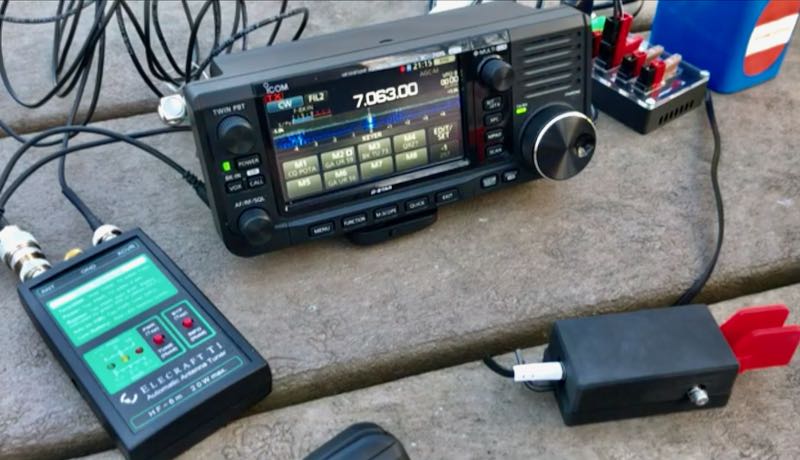 First, let me be clear, in Douglas Adams terms: Don’t Panic!
We’re not watching the end of amateur radio. We’re simply entering a different part of the cycle.
I’m not a solar physicist or a propagation expert, so I’m not going to even attempt to explain the science behind solar cycles here.
What I can do is talk about what I’ve experienced as an amateur radio operator since 1997, and especially what I’ve learned operating portable and QRP through different conditions.
And I think there’s some good news.
 Solar Cycle 25 reached its maximum phase in 2024, according to NASA and NOAA, and we’re now moving into the declining phase of the cycle. We still don’t know exactly when we’ll reach the next solar minimum, but we’re talking years rather than months.
If I’m being honest here, I sometimes felt that we were a little cheated by this solar cycle.
The numbers were good. There were plenty of sunspots, and I experienced some of the best DX I’ve ever worked from the field. But there was also considerable instability, including geomagnetic storms that sometimes seemed to arrive just when conditions otherwise looked promising. I recall several Hamvention weekends in a row when conditions were so poor, groups of us struggled to make contacts even when there was a lot of spotted activity.
That’s one of the things I’ve learned over the years: no two solar cycles are exactly alike, and even within one cycle, conditions can vary enormously.
When I first became licensed in 1997, I remember some periods when 10 meters was absolutely spectacular–effortless, armchair copy transatlantic voice contacts at QRP levels. During the current cycle, I’ve certainly enjoyed 10 meters and the other higher bands, but I don’t feel that I’ve experienced the same consistently spectacular conditions I remember from those earlier years.
That’s just the way it is.
Sometimes the Sun cooperates. Sometimes it doesn’t.

For many scanner listeners, the appeal is easy to understand. You turn on a radio and, without knowing what will happen next, you can hear pieces of real life unfolding around you: a fire call, an aircraft approaching an airport, a railroad crew at work, severe weather reports, public works activity, or emergency responders handling an incident.
But how did listening to public-safety radio become a hobby in the first place? The answer starts decades before the modern police scanner existed. The hobby grew alongside police radio itself, then changed repeatedly as communications technology moved from early AM broadcasts to VHF and UHF, crystal-controlled scanners, programmable radios, trunked systems, digital communications, online databases, and today's sophisticated receivers.
In other words, the history of scanning is not simply a history of old radios. It is a history of people wanting to know what was happening around them, and technology gradually making that easier.


With heavy hearts, the Massachusetts State Police announce the unexpected death of Trooper Jacob Mick who died from injuries sustained in an off-duty motorcycle crash in Grafton.
A member of the 88th Recruit Training Troop assigned to the Holden Barracks, the life of this 31-year-old Northboro native has been cut short by this enormous tragedy.
Speaking of the late Trooper, the Superintendent of the State Police, Colonel Geoffrey Noble said, “Together, we mourn Trooper Jacob Mick, and extend our deepest sympathies to his wife, their infant daughter, his family, and all who loved him. He was a proud Trooper and public servant who never hesitated to answer the call. We remember and honor Trooper Mick’s years of service, and all he gave to the Commonwealth as well as to the Department.”
Trooper Mick graduated from the Massachusetts State Police Academy in 2023.
The facts and the circumstances of the crash remain under investigation by the Worcester County District Attorney’s Office.
At this time, the Mick Family requests privacy as they grieve. Further information will be provided as it becomes available.
I'm personally devastated by this. I'm not 100% sure, but this young Trooper looks like the young off duty trooper who assisted me at the scene of a motorcycle accident at the exact same location last October. I was the first to arrive and together we applied first aid. I'll never forget his calm professionalism and compassion.
Whether this is the same trooper or not, it makes no difference. This is a devastating loss for his loved ones and the Commonwealth he served.
Rest in peace Trooper.
