
The Solar Cycle Is Changing. Don’t Panic.
Several people have asked me lately what it’s going to be like as we move out of Solar Cycle 25 and eventually into the quieter years between solar cycles.
I understand the question and why so many ask.
There’re a lot of new amateur radio operators who came into the hobby during the pandemic. Many of them discovered amateur radio through things like Parks on the Air (POTA), Summits on the Air (SOTA), portable operating, and DXing. They’ve experienced a pretty active solar cycle in the past few years, and for some of them, this will be their first experience with the other side of the cycle.
So what happens when the Sun quiets down?
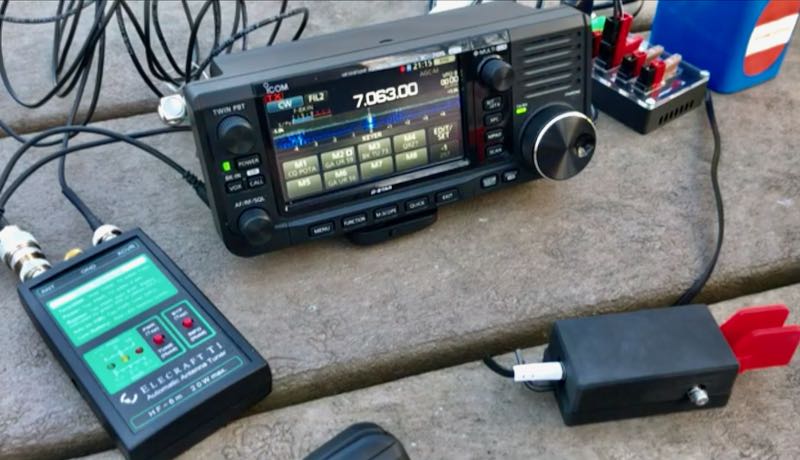 First, let me be clear, in Douglas Adams terms: Don’t Panic!
We’re not watching the end of amateur radio. We’re simply entering a different part of the cycle.
I’m not a solar physicist or a propagation expert, so I’m not going to even attempt to explain the science behind solar cycles here.
What I can do is talk about what I’ve experienced as an amateur radio operator since 1997, and especially what I’ve learned operating portable and QRP through different conditions.
And I think there’s some good news.
Solar Cycle 25 Wasn’t Always as Cooperative as It Looked
 Solar Cycle 25 reached its maximum phase in 2024, according to NASA and NOAA, and we’re now moving into the declining phase of the cycle. We still don’t know exactly when we’ll reach the next solar minimum, but we’re talking years rather than months.
If I’m being honest here, I sometimes felt that we were a little cheated by this solar cycle.
The numbers were good. There were plenty of sunspots, and I experienced some of the best DX I’ve ever worked from the field. But there was also considerable instability, including geomagnetic storms that sometimes seemed to arrive just when conditions otherwise looked promising. I recall several Hamvention weekends in a row when conditions were so poor, groups of us struggled to make contacts even when there was a lot of spotted activity.
That’s one of the things I’ve learned over the years: no two solar cycles are exactly alike, and even within one cycle, conditions can vary enormously.
When I first became licensed in 1997, I remember some periods when 10 meters was absolutely spectacular–effortless, armchair copy transatlantic voice contacts at QRP levels. During the current cycle, I’ve certainly enjoyed 10 meters and the other higher bands, but I don’t feel that I’ve experienced the same consistently spectacular conditions I remember from those earlier years.
That’s just the way it is.
Sometimes the Sun cooperates. Sometimes it doesn’t.
We’ve Already Been There. Many times.

Here’s the part I think should reassure portable operators.
When I first started doing Parks on the Air activations, including during the early days of the program, we were already operating in relatively poor solar conditions.
In 2019 and 2020, I was doing a lot of my activations on 40, 30, and, yes, 60 meters, with some 80-meter operating thrown in—particularly later in the afternoon and evening.
And it worked fine.
It wasn’t always easy. In those early days of POTA, the program was dramatically smaller than it is today. There weren’t nearly as many hunters listening for activators, and I sometimes had no idea whether I was going to make my ten contacts.
We activators and hunters were a close-knit community.
I relied heavily on friends who knew I was going out, announcements before an activation, reverse beacon network spots, and automatic spotting. When I went somewhere remote without cellular service, getting that spot onto the POTA network could make or break an activation.
In fact, I think this is an important distinction for today’s POTA operators: the POTA community is vastly larger and more active now than it was when I started.
There are a lot more hunters out there. This is good news, indeed!
That alone changes the equation in no small way for the portable operator heading into the solar doldrums.
Your Lower Bands Are Going to Become Your Friends

As solar activity declines, the higher HF bands will generally become less reliable for long-distance propagation. That doesn’t mean 10, 12, 15, or 17 meters will suddenly become useless. Far from it! There will still be openings, sometimes brilliant ones. They may be fleeting, though.
You won’t be able to count on them the same way you can during the solar peak.
This is where 40, 30, 60 and 80 meters become particularly useful.
I’ve always considered 40 meters one of the great portable bands, and during poorer solar conditions it becomes even more valuable. Thirty meters can be wonderful for CW and digi modes, while 60 and 80 meters can give you additional options, particularly for regional and nighttime contacts.
 That doesn’t mean you should abandon 20 meters, either. Don’t make the mistake of thinking that solar minimum means 20 meters is dead. Propagation depends on many factors besides sunspot number, including time of day, season, path, and geomagnetic conditions. Historical low-solar-activity propagation reports show that 20 meters can remain quite useful, while 40 meters and below become increasingly important.
The larger lesson is simply this:
Don’t become dependent on any one band. Frequency agility is key!
In the past two years, I’ve known activators who almost exclusively rely on 20 meters. It’s been so active that there’s been no pressing need to change bands if your only goal is to get the minimum contacts for a valid activation.
 If your portable station is currently optimized for 20 meters and above, this might be a good time to start thinking about adding 40 meters and perhaps 30, 60 or 80 meters to your capabilities.
For example, if your only field radio is a high-band QMX, you might eventually consider adding a low- or mid-band QMX to the mix.
At the end of the day, though, the point isn’t to buy more equipment.
The point is to have options.
This Is Also a Good Time to Improve Your Antenna Game
 Lower frequencies generally mean larger antennas.
That’s one reason I’ve always liked portable wire antennas. If your operating environment allows it, a 40-meter EFHW, a long random wire, or a suitable dipole can give you considerably more efficiency than trying to force a tiny ground-mounted, coil-loaded, vertical antenna to do the job.
If you operate in parks where putting a line into a tree is permitted, this might be a good time to learn how to use an arborist throw line. Practice at home (preferably with no family members observing you abusing a tree–!). Learn how to get a wire into a tree efficiently and safely before you’re standing in the middle of a park trying to figure it out.
If trees aren’t available—or if the park doesn’t permit that sort of thing—a good portable mast gives you another option.
None of this means that your little vertical antenna is suddenly useless.
 You can absolutely make contacts with an Elecraft AX1 on 40 meters during the solar cycle’s doldrums. You can make contacts with all sorts of compromised antennas. And with enough hunters listening, you’ll probably be surprised by what you can accomplish with, say, 1 watt of power (you know I’ll go there, right?).
But reality check here: if propagation is already making the job difficult, antenna efficiency matters even more.
Learn to Adapt to the Band Conditions
 One of the best habits you can develop as a portable operator is to stop thinking of your activation as being tied to one band.
Test the bands, starting with 40 and 30. If the higher bands suddenly open, take advantage of it!
In fact, I used to hit 60 meters a lot in those early days of POTA and even had my KX2 pre-programmed with the then-channelized segments.
This is one of the reasons I love portable radio. You’re already outside, and your entire station, that you just deployed from scratch, is sitting in front of you. There’s no reason you can’t experiment while there! That’s part of the fun!
Change Your Definition of a Successful Activation

During a strong solar cycle, it’s easy to become accustomed to big pileups and unexpected DX. It’s wonderful, but it can also distort your expectations.
A quiet solar cycle gives us an opportunity to remember that an activation doesn’t have to produce a bursting-at-the-seams log to be successful.
Maybe you work ten stations? Maybe you work five? Maybe you work a few difficult regional contacts? Maybe you get one or two unexpected DX contacts that make your entire afternoon.
Or maybe you simply hike to a beautiful summit, put a radio on the air, and make only two contacts before packing everything up because of your schedule constraints.
That’s still an activation. Maybe it’s not “validated,” but hey! This has happened to most of us at some point. Builds character, I say!
And personally, I think those difficult activations can sometimes be more memorable than the ones where you spend an hour buried under a giant pileup.
Don’t Waste the Quiet Years
 If you’re a new amateur radio operator who has only experienced the relatively favorable conditions of Solar Cycle 25, this is going to be an interesting learning experience. You can totally handle it. Don’t panic!
You may have to change your expectations. You may have to become a little more patient, listen more carefully, and work a little harder for some contacts–take more time in the field. But you’ll still make loads of contacts. You’ll still work DX. You’ll still activate parks and summits. And you’ll still have those magical days when propagation suddenly opens up, and the bands come alive. In fact, those days will feel even more special when you’ve had to wait for them.
So don’t look at the coming solar minimum as the end of the fun. Look at it as another phase of the game! I’ve been through several of these cycles now, and I can tell you that there’s still plenty of radio to be made when the Sun isn’t particularly interested in helping us out.
This isn’t something to worry about. Trust me: you’ll be fine!
We’ll all adapt, and we’ll have loads of fun along the way!

No comments:
Post a Comment
Leave your comment!